Feb 5-7 Denver. Eric to Present at the Rocky Mountian Training Day

•January 13, 2014 • Leave a Comment

RMOUG logo

Eric is presenting at the yearly Training Days hosted by the Rocky Mountain Oracle User Group – one of the largest Oracle User Group in the nation.

February 5-7 at the Denver Convention Center

Register today so you don’t miss out on these highlights:

  • Two full days of training with a bonus half-day of two-hour Deep Dive Sessions
  • More than 100 technical sessions
  • Full exhibition
  • Networking opportunities to meet and talk with Oracle ACE Directors and ACEs, Product Managers from Oracle, and other Oracle professionals
  • Encore Women in Technology (WIT) panel


11.1.2.3.500 The rumor mill

•January 9, 2014 • 2 Comments

Rumor has it that Patch Set 11.1.2.3.500 should be released this quarter.

For all of those that keep asking for the capability, we are getting indication that indeed IE10 and Office 2013 will be supported in this release.

They are also calling this version the mobile version.  As I have alluded to before in past posts, we can expect the much anticipated mobile apps around workflow and other mobile capabilities especially around Planning and reporting.

I also hope that we can truly get backwards compatibility in LCM that was published as working in the last release but does not. See my blog post on this:

https://erichelmer.wordpress.com/2013/05/14/dont-believe-the-hype-11-1-2-3-lcm-backwards-compatibility/

Other things I am hoping for in this patch:

  • Windows server 2012 support
  • Windows 8 support
  • Firefox v24

Some other things that I am expecting in the near future, but would be surprised if they  make the Q1 .500 PSU.  If I had to guess, we will have to wait until 11.1.2.4 (prob in Sep/October):

  • Significant ADF improvements.
  • HFM on unix, Exalytics
  • Much more integration with HPCM.
  • Continued integration with DRM, especially with FDMEE
  • FDM to FDMEE upgrade utility
  • More seamless data syncing between the products

As Always, we will be on the forefront of all the new capabilities in this coming release.  Stay tuned to this blog for the latest.

Yes you can afford Oracle EPM – how to get started for less.

•January 6, 2014 • Leave a Comment

Yes you can afford Oracle EPM – how to get started for less.

Let’s face it, implementing Oracle software can be an expensive undertaking.  After doing some quick analysis, many companies who desperately want to get out of the spreadsheet rat-race feel over burdened with the perceived high cost implementing an enterprise solution for performance management.  No company is adverse to spending money if it will yield a worthwhile return. But if you are new to EPM, getting a handle on the overall ROI with EPM and BI can be challenging.

  • What value will the EPM solution bring?
  • What cost savings will be realized as a result?
  • What quality will be improved?
  • What risks will be reduced?
  • How much time will be saved?

Of course, the flip side to this is cost.

Let’s break down the major cost factors for an EPM implementation, outline some considerations for each, and identify opportunities to reduce cost.

1.)  Software Licensing and support

Most Oracle EPM modules are priced by the number of application users and can be thousands of dollars per user.  There is also the cost of support which entitles you to software updates.

Oracle’s pricing list is here

 http://www.oracle.com/us/corporate/pricing/price-lists/business-intelligence-price-list-071347.pdf

 Considerations:

Oracle EPM software pricing can be done with a suite of products that come with many popular modules and the ability to add on options. You can also purchase each individual product standalone.

The way to save:

  • Every product has a minimum number of users you must purchase.  Organizations just getting started in EPM could consider the minimum user license for now, you can also add more users later.
  • Only buy what you need.  Many times the all-in-one suites have many modules you do not need.  Perhaps looking at a standalone module would be best to start with and add on as needed.
  • Many organizations split the cost between multiple organizational divisions to help reduce the burden to the individual cost centers.
  • Implement a phased approach.  Implement one module at a time, for a core group of users, then expand.

Where we can help:

We can perform a full assessment of your overall EPM, BI, and reporting vision to assist you in software selection, capabilities, and add-ons you need, identify phases, and ascertain overall cost and ROI.   We can also help in your negotiations with Oracle, and even help you write an RFP if you want to send it out for bid.

2.)  Hardware

While software licensing costs can be somewhat straight forward, often times hardware costs can be a black box.  Understanding all the necessary servers, network equipment, disk storage, required third party software, etc. can be daunting to the point of giving up.   However, this information is simply mandatory to adequately cost out your project.

  • Operating System cost
  • Server cost – based on required CPU, Memory
  • Disk Storage
  • Required third party software such as Oracle database or SQL Server.

Considerations:

There are many factors that will influence what is required for hardware.  The number of environments, users, uptime/availability requirements, and understanding what internal technology that can be leveraged such as pre-existing Storage Area Networks. The only way to know for sure is to have a professional hardware design performed.

 The way to save:

  • Consider cheaper operating systems, such as Linux.
  • Consider virtual machines to lower the physical hardware footprint.
  • Only buy what you need.  Consider starting with only a DEV and PROD for now.

How we can help:

We perform a standard one-day hardware design session with your organization to completely understand the use case, modules, scalability, security needs, service level needs, etc. It is a very quick and inexpensive offering that can prevent a lot of budget surprises.

Still too expensive?   Have us deal with it for you.

We also offers Oracle EPM and BI server hosting.  Using our cloud hosted services, organizations save big time by eliminating the large cost of servers (That have to be replaced every few years).  Also eliminated is the infrastructure space, electricity, etc. Our hosting service provides:

  • Secure high-speed access to servers over secure VPN – the servers look like they are directly on your network, so data integration is a snap.
  • Full high-availability fault tolerance.
  • Full data center disaster recovery with geo-redundant storage.

3.)  Software development and training

The possibilities with the Oracle EPM stack are seemingly infinite. However, it has to be developed.  The installation creates a blank canvas and it needs to be developed and configured which takes time, money, and know-how.

Considerations:

Even the smallest greenfield implementation will undergo these major steps:

     1.)  Design/Assessment
     Dimensionality, reporting, data integration, etc.
 
     2.)  Implementation
     Configure the software to the design
 
     3.)  Testing
     Conference Room Pilots, User Acceptance Testing, etc.
 
     4.)  Training, documentation
     User and Admin training
 
     5.)  Roll-out
     Go-live, parallel close cycles,
 
     6.)  Expand
     Adding additional functionally, users, divisional units, detail, modules, etc.

The way to save:

  • Implement a phased approach.  Start with one module, one application, and simple reports. Go-live and get user acceptance, then expand capabilities.
  • Use an implementation partner to train your people so that they can continue with the application development, reports, etc.

How we can help:

We have dedicated rapid deployment programs specifically for midsize companies seeking to get up and running fast.  We have fast tracks for rapidly deploying Business Intelligence (OBIEE), Planning, Financial Management, and Data Relationship Management.  This program is perfect for those that want start their journey away from Excel and embrace an enterprise solution as a quick win first step. The scope is clear, implementation is quick, with detailed training and documentation throughout.

4.)  Ongoing administration, support.

Just like all enterprise system, this is not a set-it-and-forget-it solution.  Oracle EPM requires ongoing administration and support both functionally and from IT.

  • Data and metadata loading
  • Calculations, aggregations, consolidations
  • User access issues
  • Server maintenance and troubleshooting
  • Backups
  • Patching
  • Monitoring

Considerations:

This typically involves many people.  While it may not be a full time job for any one individual, it does involve many skill sets.  Functional admin users are usually the first line of support for issues.  Technical issues could easily involve server admins, database admins, network admins, etc.  Most importantly, someone needs to create, maintain, monitor, and test backups and recovery procedures.

The way to save:

Ensure you are working with a partner that takes administration and IT training seriously. Properly spending time training admins up front will significantly save time and money in the long run.

How we can help:

We offer all sorts of training including administration training and dedicated IT training covering proper maintenance, troubleshooting, logging, backup/recovery, architecture, scalability, tuning, etc.

If you are understaffed – have no fear.  No need to go out and hire full time people, we offer worry-free  Managed Services and Helpdesk services for companies of all sizes.  For midsize companies getting started in EPM, we offer a low-cost basic package for Helpdesk services; including a fully functional web based ticketing system and 15 minute service-level ticket acknowledgment from our knowledgeable on-shore Helpdesk team.  This service can save you 60-70% in overall costs associated with day to day maintenance and support costs.  For companies wanting more IT services, our fast reacting helpdesk can do ongoing proactive health monitoring, job monitoring, backups, tuning, patching, etc.

Summary

It’s obvious that there many possibilities to implement EPM.  Whether you are looking start a new EPM project, reduce costs of your current implementation, upgrade, improve support, etc…. it all starts with discovery workshop.  We will help you justify your ROI, calculate costs, and go over all your options to ensure you are not overbuying, over allocating, or inaccurately budgeting.

It is possible to start your journey to EPM on almost any budget.  Contact me for more information on how to get started.

Oracle Planning and Budgeting in the cloud update

•November 19, 2013 • 1 Comment

Oracle Planning and Budgeting in the cloud update.

Last October,  I posted an article on the capabilities of the Oracle Planning and Budgeting Cloud Service (PBCS) Cloud and asked if it was right for you.  It’s been a full year, and while Oracle has yet to still to have a public offering, there have been some changes.

They have made some improvements/themes that are worth noting.  The new official time frame for the release of the PBCS is in the first half of next year. The word is that all the coding is done; it’s just a matter of packaging it with the Oracle Public Cloud offering.

I am hearing that that the initial pricing will be $120 per user per month with a 10 user minimum, for a 1 year minimum.

Theme

The Theme of the PBCS is “Rapid Deployment”.  In essence, it is intended to be a way to get up and running quickly with the basics.

Highlights:

  • Software licensing built in
  • No need for hardware infrastructure support
  • System patches and upgrades are part of it an free – always have access to the latest features
  • Built in wizards, advisors, training to ensure best practices

They also claim “IT won’t mind.”  Hyperion Planning is sometimes considered to be a financial specific one-off system that may not perfectly fit into IT standards.  Many times it does not need a lot of day-to-day care and feeding but it can cause havoc when it needs attention.  Therefore Oracle claims that IT will be happy to allow you to place the system off premise and even have an external entity completely manage it.

Maybe, maybe not…regardless, who can argue with the quick, agile and scalable model the cloud has to offer – if the capabilities meet your needs.

Capabilities

You get ONE planning application only

  • No EPMA
  • up to 4 plan types (ASO or BSO)
  • no modules (CAPEX, WFP, etc)

Patches:  Patches can be scheduled, but they are mandatory.  Oracle will only support the last release and the release prior. You will not be able to back out patches.

Backups: Essbase data is backed up once per day.

Training: Tutorials start from the basics of Planning and multidimensionality to advanced administration.  There are also videos that are more geared for end users to get them familiar with the system. The landing page has a Cloud Documentation Center with other various documentation. Guided demo applications are available complete with task templates to get started.

Diagnostics:  There are built in application diagnostics that assist you with your applications.  It will have advice and guidance that identify design flaws such as outline structure, ordering, block sizes, etc.  There are also built in run-time governors that will warn you if you reach a frowned-upon threshold.

Scalability: built-in automatic scaling as you add users and usage

High Availability:  Built in fault Tolerance and redundancy

Other Administration:  Admin functionality added to Excel, log diagnostics.

Target Markets

So who is this cloud for?  I see this being a viable option for the following:

New Accounts

  • midmarket companies that are not able to buy full licenses and/or maintain IT infrastructure.  A great way to get midmarket companies out of  spreadsheet mode into a feature rich robust planning solution that larger companies use.

Existing Accounts

  • Business that want to expand additional business units where the current hardware or budget is restrictive.
  • Existing non-planning EPM customers that want to expand into planning where the current hardware or budget is restrictive of that expansion.
  • Customers on 11.1.1.4 with only 1 classic planning application (no modules or EPMA) that want a quicker way to upgrade or to test latest features.
  • A Sandbox. Customers that want a place to test something out in a non-prod environment or have a place for development without the need for an IT overhead. Or a temporary place to start development while on-premise hardware is acquired.

The Cloud Rapid Deployment Life cycle

PBCS 

Of course, the money maker for Oracle are net new mid-market accounts that want to start learning, using, and adopting Hyperion planning in their organizations.  The cloud offers them an inexpensive way to get started.  The hope, of course, is that these companies either continue to expand their use in the cloud or eventually purchase the licenses and move it on-prem.

What does a “Rapid Deployment” project look like for a first adopter?

The key is to do a phased approach, starting with just the basics, go-live, then expand capabilities. The K-I-S-S method for the initial phase is crucial.

1.)  Start with the basics

  • Design – identify Critical Forms, Reports, Calc
  • Build-out

2.)  Go-live

  • Training and familiarization
  • Adoption

3.)  Expand Capabilities

  • Additional features, detail, reports, forms
  • Additional users, departments, etc

The Initial Phase

Target for initial rapid deployment

  • Less than 20 users
  • Less than 8 dimensions
  • 5 calculations (ie –% sales, % salary, Rate per headcount, etc)
  • less than 10 entry forms
  • less than 10 reports
  • less than 3 task lists
  • simple profit and loss, no operational planning

The Rapid Deployment Project could be an average of 4-8 weeks depending.

  • 1-2 weeks design
  • 3-5 weeks build
  • 2-3 weeks training, deploy, roll-out

Later Phases

Expansion

  • Additional dimensions, calcs, forms, reports, task lists, etc.
  • Additional users and departments
  • Full financial statements (Balance Sheets, Cash Flow)
  • Operational Planning


How do you get on the Cloud?

Whether you are a new company looking to get out of the spreadsheet rat-race and take a serious look at Oracle’s Planning offering, or an existing customer that would like to get your application up on the latest version, we are ahead of the curve when it comes to the cloud.  We have assisted Oracle in their pre-view launch and have deployed applications to it.  We are developing an all-inclusive fast track package that will get your organization in the cloud inexpensively using our methodology.

Stay tuned to this blog as I will announce when the cloud is available and give you details on how we can get you up and running in no time.

The Top 10 Hyperion IT Maintenance Activities That Cost You Time and Money!

•October 14, 2013 • Leave a Comment


I often get asked “How many FTEs do I need to maintain my Hyperion system?”

Of course the answer is it depends. Let me outline the top 10 maintenance activities to properly maintain and support your Hyperion system from an IT prospective…

1.) Keep it clean

It’s important to keep the system clean. Over the years, we accumulate stale an unused reports, applications, data, etc. It’s especially important to ensure you remove and deprovision any users that are no longer valid. I recommend a quarterly cleaning. Stale security, applications, and data can impact performance and make upgrades messier.

2.) Backups and disaster recovery

A good backup process is mandatory. There are two types of backups:

  1. Full server wide backup (while services are stopped) along with the database backups. This protects from a server wide issues.
  2. Object level backups including security, reports, applications, and data. This protects from individual object level issues or corruption.

The best approach is to do both, assuming you have the maintenance window to do so. Set a reasonable retention policy and store backups off-site. Restore procedures should be fully documented and tested. Your backup/Recovery and disaster/recovery procedures are only as good as your last full test. They should be tested annually.

3.) Log Rotation

The Hyperion logs can get huge if left alone. Large log files can seriously impact performance as well. Periodic log rotation is needed

4.) Patching/upgrades

Patches are released all the time. It important to keep updated on what’s out there. Just make sure you do not just simply install patches simply because they are out there. You should apply only those that exactly match issues and the products/configuration you have.  Upgrades need to be carefully thought out and fully tested.

5.) Nightly Jobs

In almost every case there are nightly data loads, calculations, backups, consolidations, etc that run and these jobs need to run on time. We must be alerted if jobs fail. Monitoring, automating, and resolving issues with nightly jobs can be time consuming depending on the complexity and frequency.

6.) Troubleshooting and Issue resolution

Of course no system is perfect. An IT staff needs to be ready and on call to support the system at all times. Even if users only use the system during normal business hours, the system is just as critical at night in most cases as important jobs are being run. IT administrators must deal with anything from server issues to end user connection problems.

7.) Health Monitoring

An IT staff should be prepared to periodically check the health of the system by fully logging in, checking logs, services, process, memory utilization and other system resources, etc. Of course this can be done programmatically using standard industry monitoring tools as well.

8.) Helpdesk and Issue Ticketing/Tracking systems

Integrating the Hyperion system with a corporate Helpdesk is becoming more and more common. However, a lot of the time the helpdesk is simply just opening a ticket and not really doing level 1 support, which makes them more of a ticketing overhead than providing true helpdesk services. Training the helpdesk to do level one support can help reduce the time needed by IT staff.

9.) Change Management

IT may need to get involved when migrating objects from DEV to TEST to PROD. Sometimes we need to move files between servers, move databases, etc. Truly understanding everyone’s roles and responsibilities for change management and object promotion is key.

10.) Periodic IT/Finance meetings

I recommend a monthly meeting between the business users of the system and IT. It’s important to talk about general issues, service levels, root cause analysis of historical problems, performance, and what’s on the horizon for changes coming up.

Seem like a lot? It is. Is it a full time job? Depends. Either way, day-to-day maintenance activities like these can be a killer on todays IT administrators that are supporting many enterprise systems at a time, not to mention implementing new projects constantly.

One option to reduce cost and risk but to ensure these activities are always being done is to leverage our Managed Applications group.  It is an affordable and flexible way to meet whatever service needs you have.


The basic package is simple help desk phone support for break-fix issues resolution – perfect for the environments that are mission critical, intolerant to downtime, and have a stretched or limited IT department. Our 15-minute service level ticket acknowledgement is standard and 24-hour options are available.

Additionally, you can customize your package to include a wide variety of services such as:

  • Patching and Upgrades
  • Administrative support
  • Developer and functional assistance
  • Server Hosting
  • Nighty job and backup monitoring
  • Proactive server monitoring using automated agents – we know and start resolving before you know!
  • Backup and disaster recovery
  • IT Training, best practices, and process consulting (change management, monitoring, help desk, asset management, etc)

The Managed Applications Service is a great way to free up IT for more strategic projects and outsource day-to-day Hyperion IT administration as a service, for far lees than an internal IT staff. Many companies small and large, and even some government agencies have already signed up for this very popular service.

Better up-time, better performance, better protection, faster resolution, lower cost.

Interested? Contact me for a quote: http://erichelmer.com/contactus.aspx


Rumor Mill – Planning, trends in Finance, and what’s coming

•October 10, 2013 • Leave a Comment

Rumor Mill – Planning, trends in Finance, and what’s coming

At this year’s Openworld, Oracle defended their strategic direction and themes based on some common Trends they see in Finance:

48% CFOS say IT systems are out of date and inflexible

40% can only forecast 3 months out.

93% still use spreadsheets

As a matter of fact, as much as 35% of large companies and as much as 65% of midmarket companies are still using spreadsheets for planning/budgeting

Why so high in Midmarket?  Because the high cost of an IT infrastructure and full software license ownership has been quite a challenge.  In order for Oracle to continue to compete in this market, they must go head-to-head with some of the SaaS EPM leaders such as Host Analytics and  Adaptive Planning

The Cloud push has been so strong that 11.1.2.4 is the last “on premise” code base.   11.1.3 will be a cloud based theme.  Meaning that all new development must be developed and deployed to the cloud first and then ported to the on-premise versions… so we can assume all the latest wiz-bang features will be available in the cloud first.

And we are already seeing it.  There are things that will be released in the Planning and Budgeting cloud (expected December) that may not be available on-premise.  Such as:

  • Create New Application updates
  • Build Process Task List
  • Import / Export / Data Management Capability
  • Application Monitor and best practices advisor
  • ASO Plan Types
  • Smart View Metadata Updates

There is even a friendly (or not so friendly) competition between the various internal EPM developer groups on who can get the most functionality on mobile quicker…

But EPM is not the only one… Larry’s direction is to get everything on the cloud and on engineered systems.

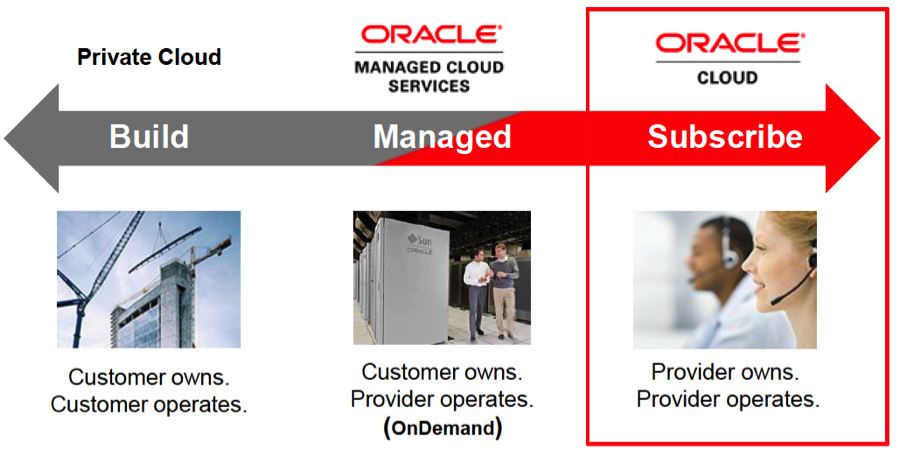
Any application, on premise or in the cloud, managed or not, owned or SaaS.

The Theme…. Is total customer choice…

  • Deliver mainstream apps in the cloud
  • Self service everything. no IT
  • Multi tenancy, data isolations, security
  • Give choices between on-premise and cloud, mix/match and integrate.
  • Include managed service model

any


HFM platform revamp  

We have been asking Oracle when HFM/FDM will be available on Unix platforms.  The answer was always that the demand was not enough for them to consider the massive recoding it would take to convert the code.  Since HFM is so dependent on Windows-only components such as IIS, DCOM, and .Net, the effort would be too massive.

Suddenly, Oracle recently announced that HFM and FDM will now support Unix/Linux platforms.  Why now you ask?   Simply because the cloud and Exalytics are both Unix based.

Oracle is also continuing to focus on improving the speed, accuracy, and complexity of the financial close process.  At the same time, we are seeing a push to include more users in the process and incorporate workflow across the enterprise.  We are seeing the close process including hundreds and even thousands of users and Oracle must attack this problem.  We need to get 7 hours long processes to less than 30 minutes. Believe me, they know this.

Within the Consolidations suite of products, we can also expect

  • Dramatically improved consolidations performance
  • Deployment simplification
  • Ability to leverage Exalytics

Planning Approach

Planning modules are a key strategy.  Oracle will continue to invest in Planning modules as quick start pre-built templates for dedicated purposes.

At this time, EAS and Essbase studio is still a go forward strategy despite the movement to Calculation Manager for Essbase administration in the cloud version. EIS is not a strategic direction.  My prediction is that a unified Essbase and OBIEE administration tool will be coming, probably leveraging Oracle Enterprise Manager.

What’s coming:

  • EPM mobile applications for Planning and HFM approvals
  • OBIEE reporting integration with Planning – through   Oracle financial planning analyzer (OFPA)
  • Full data copy for ASO
  • Seamless ASO-BSO trickle
  • Auto upgrade for modules
  • Sandboxing
  • tighter FR integration
  • Project Financial Planning and Public Sector in the cloud
  • Open dimensions in Smartview, and add dimensions,u pdate properties. (probably only for classic apps)
  • Add new plan types on the fly
  • PFP -integration to Primavera P6 and EBS projects.

For Mobile:

  • Mobile Applications for approvals – Planning and HFM
  • Reporting and BI Mobile browser friendly
  • Better interaction with forms, including data entry.

Another rumor is the addition of various functional starter kits to deploy apps quickly. Using wizards, guide you through common models, etc.  Perhaps a “driver based rolling forecast functional starter kit”

EPM Themes of OpenWorld

•September 25, 2013 • Leave a Comment

Themes of Openworld


First of all, I’d like to start out by saying that Oracle’s yearly conference in San Fran is called OpenWorld…. NOT Oracle World.  It’s amazing how many people call this conference Oracle World… even high-level presidents within Oracle at Keynotes.


With that aside…

Balaji


Balaji Yelamanchili of Oracle was clear via many sessions in Openworld that there are some clear directions from Oracle in the EPM world.


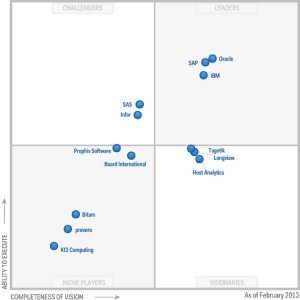
This comes from the continued success that Oracle has had with their EPM products.  Once again, oracle continues to tout how EPM Gartner surveys continue to show BI Analytics top of list for business  leaders as the most needed strategic initiative,  and of course, how Oracle as the 4 quadrant leader.

quad

From a business standpoint the themes are:

  • Establish a standard process
  • Forecast accurately
  • Manage risk
  • Respond quicker
  • Keep cost low
  • Expand outside the walls of finance


From a technical  standpoint the theme is clearly:

  • Optimization and support for all products on Exalytics
  • Mobile
  • Cloud and Oracle’s offering of their service as a SAAS model.


Exalytics:

  • New heftier box, flash storage, and now uses Solaris!
  • HFM /FDM Profitability support
  • Cloud


Mobile:

  • Using Financial Reporting on mobile devices supported
  • OBIEE visualizations
  • Mobile apps on the horizon for personalized approvals on the go
  • App developer toolkit
  • Roadmap to get planning mobile friendly including data entry.


This may be a surprise to some of you – But Oracle semi quietly released a BI mobile app designer in August. 
 
This tool is to allow people to create specialized custom apps for any mobile device.  Designers do not need to know the underlying operating system – IOS or Android and can design for all mobile devices in on please with an easy interface. It’s actually intended for  business users, not programmers. I believe they are offing a free trail version as well. 
 
Additional Mobile browser support Smartview with Win 8 PRO (Windows surface tablet), and since the IPHONE is supported, Safari must as well I assume.


Cloud:

  • Oracle introduced Financial Reporting on the Cloud coming soon along with their intended Planning and Budgeting in the Cloud service.
  • Support for Planning modules – CAPEX, WFP
  • OBIEE in the Cloud
  • Oracles huge investment in cloud over 12 data centers around the world.


For additional direction themes, in general we see focus on more operational and financial data linkage as EPM meets predictive modeling BI.  The natural combination of EPM and BI are natural and necessary tools for business analytics.


Investment in current products:

  • Continued focus on the “bolt-on” products and modules.
  • 98% of HSF functionality is now in smartview.
  • 11.1.2.2 extended for 3 more years of support.


Going to OpenWorld?

•September 6, 2013 • Leave a Comment

Larry

OpenWorld is just around the corner.  Eric is presenting and hosting on-site consulting and brainstorming sessions.  Please contact me if you are going.

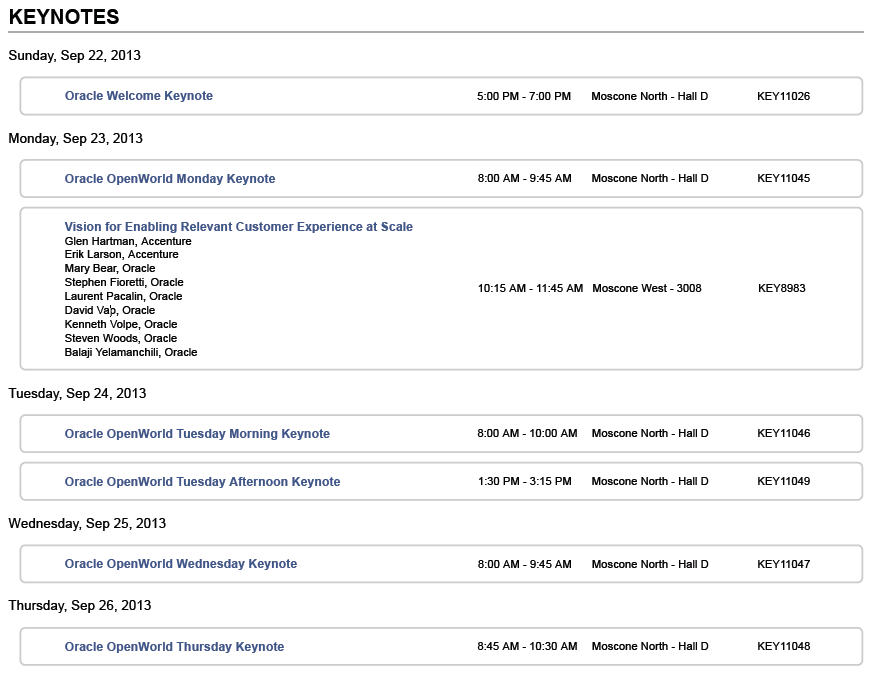
Below is a list of some ideal Keynotes you should consider attending:

Keynotes

Oracle EPM Recap and Roadmap

•August 10, 2013 • Leave a Comment

Oracle EPM Recap and roadmap

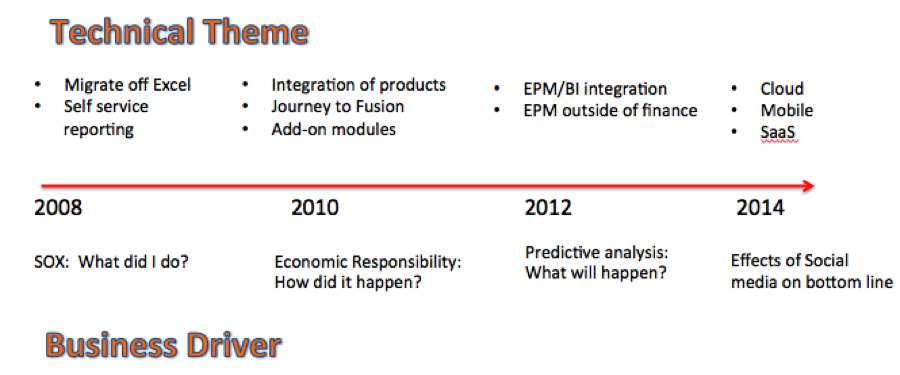
In order for us to know where we are going in the work of Oracle EPM, it important to understand where we have been.  When you really start understanding the themes we have seen with Oracle throughout the years and versions, we see how the new features are functionality in each release make sense and helps us extrapolate what we may see in the future. Lets take a moment to reflect Oracle themes over the years:

Themes

Functional Themes

  • 2008:  Migration off excel, self service reporting
  • 2010:  Cross-functional integration of products.  Journey to Fusion, plug in modules
  • 2012:  Deeper functional solutions, more complex models, ADF/Fusion,  inclusion to business oversight with TAX and projects
  • TODAY:  Integration of EPM and BI integration outside the context of Finance.  True Financial and Operational Performance management as a necessary input  for overall Business Intelligence, CLoud and SASS, Mobile

Version key features:

  • 11.1.2.0:

– Began expanded Module Strategy – CAPEX, WFP, etc.

– Office Integration

– Life Cycle Management

– 64-bit

  • 11.1.2.2  (April 2012)

– Planning on Exalytics

– Project Financial Planning

– Predictive Planning

– Strategic Finance in Smartview

– ADF conversion

– Manage the close process

  • 11.1.2.3 (April 2013)

– More products on Exalytics

– Tax provisioning

– Data Relationship Governance

– FDM Enterprise edition

So, where are we now? let’s take a Quick look at an 11.1.2.3 Recap:

Infra/Foundation

  • ODL- Oracle Diagnostic Logging, and advanced transaction based logging across products.
  • LCM cross platform support (with an *) and artifact change report
  • FDEE combines EPRI platform and FDM in workspace

Planning

  • New ease of use enhancements – many updates to PFP, WFP, Capex
  • Adding Members on the fly
  • Support for ASO
  • Integration with Hyperion Strategic Finance
Note:  There is alot of confusion on licensing the use of ASO natively with Planning.  In order to use ASO natively with Planning, you must either
– Purchase full use Essbase
– Purchase Planning Enterprise edition.
What is Planning Enterprise Edition?  It is a bundle that includes:
– Planning with modules (Capex, Work Force Planning, Project Financial Planning)
– FDM Enterprise Edition (FDM with ERPi)
– Full use Essbase including ASO for all users and products
– Hyperion Strategic Finance.
So if you want to use ASO in Planning, choose the best option for you and Planning EE maybe overkill

Profitability

  • Availability on Exalytics
  • Built in analytics
  • Performance Improvements

Consolidation/close

  • Enhancements across rules, data forms, grid definitions
  • Financial Close Module
  • Account Reconciliation Module
  • TAX Provisioning

Essbase

  • New calculation functions
  • Pass parameters to calc scripts with run time sub vars
  • Faster builds
  • 40x improvement in cross cube calculation using XREF

And what about EPMA????  I get asked all the time how many custers are using EPMA and some if the new modules.

According to Oracle, there are about 700 EPMA customers.  500 are using it with Planning or Planning + HFM.  200 are using it with HFM only.

30 plus customers have adopted and are using the new  Project Financial Planning Module.

150 plus customers using Public Sector Planning.

New in LCM – Introducing the Artifact Change Report

•May 14, 2013 • Leave a Comment

Introducing the Artifact Change Report

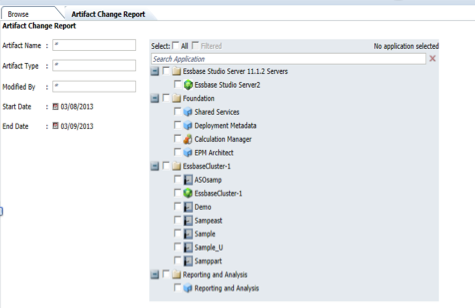
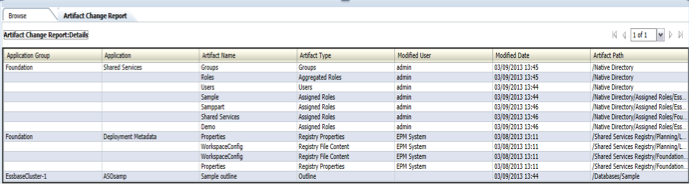
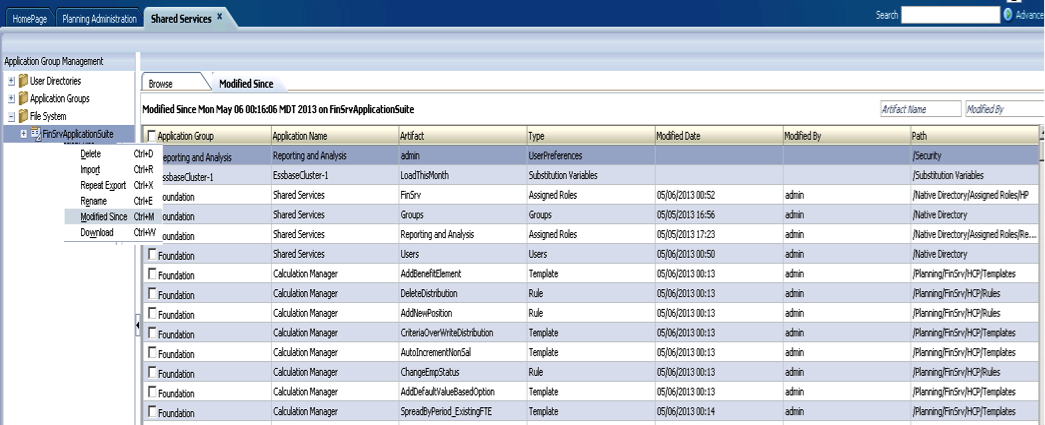
in 11.1.2.3 Life Cycle Management will give you the ability to run a report to see what artifacts have changed, when it was changed, and who made the change, including security.  You can run the report on any artifact type or granularity, or on everything.

ACR1

ACR2

ACR3

Most of all the artifacts supported in LCM are here, however some artifacts do not report time stamp changes accurately, so some things may be a little off.  Also – it does not tell you exactly WHAT has changed, only that it did in fact change.

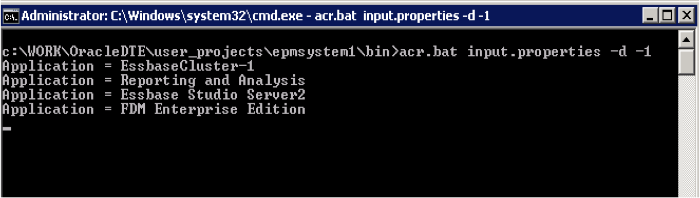
There is also a command line interface as well.

ACR5

Command line parameters:

  • input.properties – File with username and password.

     user=jdoe

     password=xyz..

  • –d: Number of days. Values are:

       -X = Fewer than x number of days

     For example, -1 generates the report for artifacts changed in the last day.

     +X = More than x number of days

  For example, +3 generates the report for artifacts changed more than 3 days ago.

  • -app: Application name

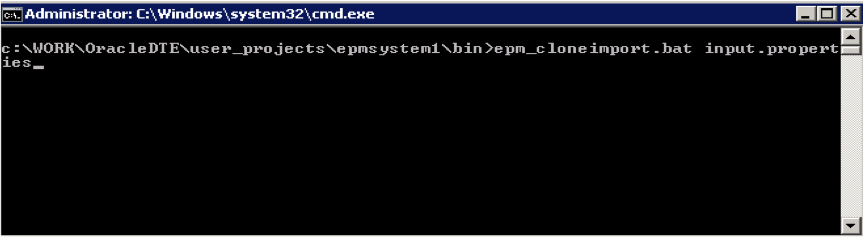
In edition, there is an EPM CLONE utility that will export out ALL applications and DATA for an EPM instance for the purposed of moving it to another system.  Yes – including data and no – you cannot tell it to NOT get data.   There is an epm_cloneexport and epm_cloneimport command line utility. ACR6