Don’t believe the Hype – 11.1.2.3 LCM backwards compatibility

•May 14, 2013 • Leave a Comment

flava-flav-social-media-marketing-networking-400x220

There is a lot of talk about some of the new features and functionality of 11.1.2.3.  One notable function is the one highlighted in a below screen shot on Oracle site…  (http://www.oracle.com/technetwork/middleware/planning/overview/index.html)

screen

Highlighted is the ability to “upgrade” applications from older versions to 11.1.2.3 using Life Cycle Management.

The truth is that in order to move objects from an older version using LCM, Oracle must issue patches to all the older versions first.  These patches must be applied prior to the LCM exports from the older system.  


The thing is:  These patches do not yet exist.

They will be targeting 11.1.1.4 first, then 11.1.2.2, and then 11.1.2.1 – in that order.  They may also be considering 11.1.1.3, however if they do not, it looks like you will be expected to upgrade 11.1.1.3 to 11.1.1.4 first before having the ability to LCM artifacts to 11.1.2.3

So don’t believe the hype… it does not exist yet.  I am hearing the 11.1.1.4 patch isn’t expected until June.

But also know that even when these patches are released, they will only be for specific versions… depending on your current version, it’s possible that you will need to upgrade older systems to a compatible step release first if you plan on using LCM for your upgrade methodology.

Until then, we will need up upgrade applications one-by-one like we always have traditionally.


11.1.2.3 dropped today

•April 29, 2013 • 1 Comment

11.1.2.3 is now available for download.  A couple of neat new things, from an infrastructure perspective:

What’s New

  • You can use the config tool to remove an EPM Oracle Instance
  • If you install FDM Enterprise edition, ODI is automatically installed.
  • You can configure Oracle HTTP server on s shared drive location
  • MSI client installers for EPM Architect, Strategic Finance, Interactive Reporting, and SQR Production Reporting.
  • Can do vertical scaling now for Essbase and most of the web services
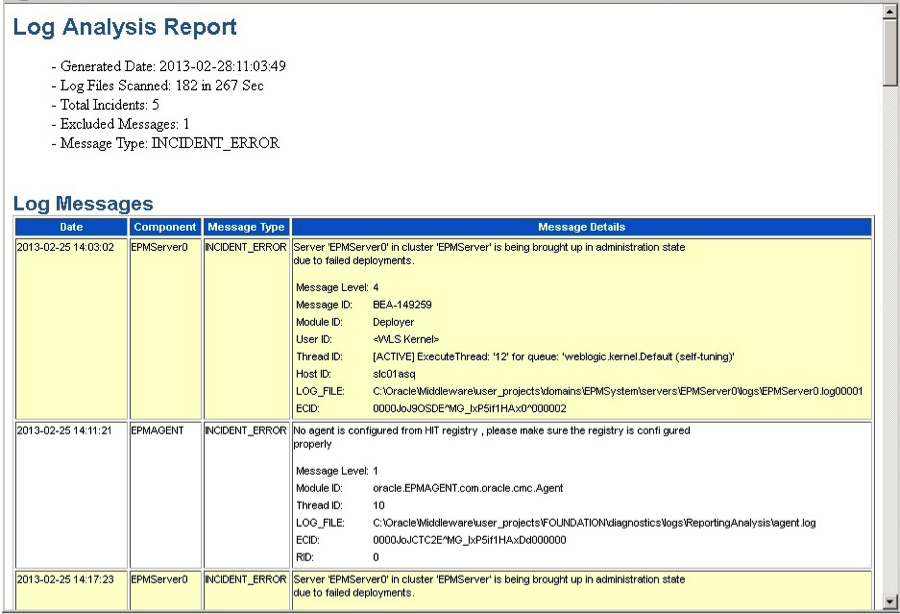
  • There is a new Log Analysis tool command line utility
  • Workspace integration with OBIEE
  • You can access the database repository with an LDAP based URL
  • There is a Port manager in the config tool that manager port uniqueness and detects if a port is already in use.
  • Documentation available in MOBI and EPUB formats.

Upgrading

There is a new EPM System Cumulative Feature Overview Tool that offers a simple way to determine the features developed between releases to assist you in upgrades.  You can get the tool here:   https://support.oracle.com/epmos/faces/DocumentDisplay?id=1092114.1

Upgrade Paths

Current version Methodology
11.1.2.x Apply in-place maintenance release 11.1.2.3
11.1.1.4.x Lift-and-shift upgrade to 11.1.2.3
11.1.1.x Apply maintenance to 11.1.1.4 and then lift-and-shit upgrade
9.3.3.x Lift-and-shift upgrade to 11.1.2.2 and then apply 11.1.2.3
9.3.x and lower apply maintenance patch 9.3.3, then Lift-and-shift upgrade to 11.1.2.2 and then apply 11.1.2.3 maintenance release.

Log Analysis Tool

Finally we get a log analysis tool that will simplify looking at logs.  We no longer have to hunt and scour the filesystem to locate logs.  This tool list errors from the entire EPM system by time, by functional issues, etc.  You can also trace the activities of a user session across all EPM system component by tracing a Execution Context ID (ECID) which is a unique identifier. The Log analysis tool creates an HTML format based report with a time stamped filename.

C:\Oracle\Middleware\user_projects\epmsystem1\bin\loganalysis.bat

Log Analysis


Can you really implement Oracle Business Intelligence Foundation Suite (BIFS) in 1 month?

•April 26, 2013 • 2 Comments


One of the newer packages from Oracle is the Business Intelligence Foundation Suite (BIFS).  The package consists of:

  • Oracle Business Intelligence Publisher 11g
    • The industry’s most scalable and easy-to-use solution for delivering high-fidelity, pixel-perfect reports in multiple formats
    • Create and modify web-based reports from a 100% thin-client browser interface as well as design and publish high-volume reports using popular desktop tools
  • Oracle Business Intelligence Enterprise Edition 11g
    • Create ad hoc queries, reports, and interactive dashboards
    • Common enterprise information model provides centralized metadata management, common query request generation and data access, and a rich spectrum of visualization, collaboration, and search features
  • Oracle Essbase
    • The market-leading OLAP server for forward-looking analysis features and advanced calculation engine, multi-user write back capabilities, and flexible data storage options
    • Ideal for scenario modeling, forecasting and planning, management reporting, and profitability analysis
  • Oracle Scorecard and Strategy Management
    • Set strategic goals and objectives that can be cascaded to every level of the organization and linked to key performance indicators so that performance can be measured, tracked, and managed
  • Oracle Essbase Analytics Link
    • Deliver effective management and financial analytic reporting to a broad user community by facilitating the real-time or on-demand transfer of financial information from Oracle Hyperion Financial Management to Oracle Essbase

So BIFS, in essence is a term for the collection of all of these products (which have existed for quite some time).  However the strategic products in this  package has value in it entirety by providing a cohesive single business Intelligence platform that can deploy all the associated capabilities and requirements of a EPM/BI system – reporting, dashboarding, scorecarding, analysis, modeling, and forecasting,etc.  The idea is to get the ability to create reports and consume data without the reliance on IT.

For Hyperion users, what does this mean?

  • Essbase can be used as a data source in dashboards along with any other data source such as EBS, PSFT, Siebel, SAP, BI Apps – all in the same dashboard splash screens.
  • OBIEE Answers can be used as a front end for HFM as well.
  • Drill through capable
  • Much better ways to visualize data

Visualization capabilities include charts, graphs, geospacial views, interactive pivots, scorcarding views, etc – all with fantastic mobile integration with common hand held devices.

Considering EPM and BI especially for midsize companies, the common question is how to get started quickly and cheaply.  How can companies lay the software down and get BIFS introduced to the organization in a useful way without breaking the bank?

Answer: Have us get BIFS up and running with the software installation, a starter application, a couple of dashboards,  handful of reports and train you to take it from there!

Please contact me for more information.

Summary list of new features in Hyperion EPM 11.1.2.3

•April 26, 2013 • 1 Comment

Hyperion Financial Management 11.1.2.3

  • Web form and grid usability enhancements:Save more POV settings in form definitions (show or hide dimensions and reorder them)
  • Save POV members as favorites for easier access (no need to open the POV Member Selector panel every time)
  • Support for dynamic POV memberlists
  • Support for on-demand rules launched per form
  • Other new HFM features:
  • General UI improvements (POV and Member Selector settings persist across HFM modules)
  • Security user access UI implemented in ADF
  • HFM modules that are not used (for example Process Control and IC Transactions) can be disabled and thus hidden from the menus by administrators via the Module Configuration panel
  • Audit log for differences after loading metadata
  • LCM supports additional HFM artifacts: application, data, audit, process management, Extended Analytics templates

Hyperion Planning 11.1.2.3

  • Support for ASO databases in Planning applications
  • Support for flexible custom dimensions that may differ in each plan type
  • Ability for end users to create dimension members on the fly (only in separate modules such as Project Financial Planning). This feature can be enabled or disabled per hierarchy.
  • Outline Load Utility implemented in the web interface: allows metadata to be imported and exported from the Planning UI
  • Access to Planning metadata in Smart View (add or update members, build hierarchies)
  • Export/import Planning metadata and data to/from a relational database
  • Task list visualizations for easier tracking (by task status, type, users etc.)
  • Planning Cloud Service: Service to be released later this year. Based on Planning 11.1.2.3.

Financial Data Quality Management (FDM) 11.1.2.3 and beyond

  • FDM rebranded as Financial Data Quality Management, Enterprise Edition (FDMEE)
  • FDMEE combines classic FDM and ERP Integrator into a single product built on the ERPI platform (ODI installed and configured automatically)
  • 11.1.2.3 will be the terminal release for classic FDM – new customers may only buy FDMEE
  • FDMEE will be released in phases (11.1.2.3 GA, 11.1.2.3 Patch Set 1 and Patch Set 2)
  • Core FDM features present in GA version but features like full HFM adapter functionality will follow later in PS1 and 2.
  • Some functions to be introduced in PS1 and PS2:
    • Scripting in Jython
    • Integration with DRM
    • Data synchronization between all EPM application types
  • HSF adapter
  • FDMEE UI is integrated in EPM Workspace

Financial Reporting 11.1.2.3

  • Old dog learns new tricks – FR reports and books to be supported on mobile devices via native browsers on each platform:
    • iPhone and iPad (iOS5 and 6)
    • Android phones and tablets (Android 3.x and 4.x)
  • Mobile support allows read-only access with POV selection, prompts etc. but no authoring or scheduling features.
  • Improved Smart View support (full FR formatting available when using Function Grids in Word and Excel)
  • Create a cover page before TOC in report books

Smart View

  • Upcoming SV features (some already present in 11.1.2.2.310):
  • OBIEE functionality added (view created content, program OBIEE objects in VB etc.)
  • Performance improvements
  • Improved ad-hoc functionality: change POV on the grid, perform operations on multiple cells etc.
  • Expanded VBA toolkit

Hyperion Strategic Finance 11.1.2.3

  • Smart View functionality greatly extended to provide full MS Office integration (complements the HSF Windows client)

Disclosure Management 11.1.2.2.300

  • Note: Release already available.
  • New publishing options: PDF generation, EDGAR-ready HTML output
  • Variables for automating common text and TOC items
  • Several UI improvements in Report Manager

Financial Close Management 11.1.2.3

  • Lots of new features in ARM (Account Reconciliation Manager):
  • Advanced user assignments (backup assignments, team/group assignments etc.)
  • Extended Auto Reconciliation module
  • Improved data load functions
  • UI improvements

Hyperion Profitability And Cost Management (HPCM) 11.1.2.3

  • Addition of Calculation Rules for combining existing model artifacts, assignment rules and drivers into a single function
    • Simplifies definition of assignment logic for groups of sources
  • HPCM is certified on Exalytics since 11.1.2.2.350
  • Smart View integration for drill-through links and custom queries to Excel

Smart View for Office Release 11.1.2.2.310 announced

•February 8, 2013 • Leave a Comment

A new version of Smart View was recently announced.  This version addresses many bug fixes for general Smart View issues as well as bugs associated with Essbase, HFM, Planning, and Reporting and Analysis.  It can be upgraded from any version from 9.3.3 and higher.

There are a few ways to install this.  Manually, or you can have it auto upgrade.  It is supported on Office 2007, 2010 32-bit, and 2010 64-bit.

However, it also comes with some new features, especially around OBIEE integration.  Below are some highlights.


1.) Support for Oracle BI EE

This version of Smart View supports OBIEE 11.1.1.7 and higher.  Operations such as the following are supported:

  • connecting to the Presentation Server and Catalog
  • importing Answers Views
  • Copying data, metadata, and views into Smart View document
  • Interact and manage imported content – prompt views, refresh, mask, copy/paste
  • Using Visual Basic code to program your own OBIEE interfaces


2.) Storing Shared connections in a local client XML file

Using a local XML file on the client, you can push out shared connections.  You have to point the shared connection URL in the options to the location of the file and then it looks like any other shared connection.

Also shared connections can now be shared in functions for Essbase, HFM, and Planning.


3.) New Document Contents Pane

There is a new task pane in Smart View that shows the document content view of the current office document in tree format.


4.) HsGetValue Functions Can Be Copied and Pasted

You may now copy cells and ranges of cells containing the HsGetValue function from one Office application and paste them into Excel, Word, or PowerPoint.


5.) New Reporting Object: Office Table

You can now import an “Office Table” object into a Financial Reporting, Essbase, and HFM grids.

Office Tables are display results in MS word and look like part of an Office document, but the members and data in the table cells are connected to the Smart View provider and are refreshable.


6.) POV Supports 5,000 Members

The POV now supports a maximum of 5,000 members.

Eric to present at this year’s BIWA Summit Jan 8-10 near Oracle HQ

•January 4, 2013 • Leave a Comment

Image

Bring in the new year by attending this year’s BIWA Summit Jan 8-10 at the Sofitel Hotel in Redwood City, Ca.  The Business Intelligence Warehousing and Analytics Special Interest Group (BIWA SIG) puts on one of the premier technical conferences dedicated to:

“The Oracle BIWA Summit brings together Oracle ACE experts, customers who are currently using or planning to use Oracle BI, Warehousing and Analytics products and technologies, partners and Oracle Product Managers, Support Personnel and Development Managers.  Everything and everyone that you will need to be successful in your Oracle implementations will be at the Oracle BIWA Summit, Jan 9-10, 2013.” (www.biwasummit.com)

Eric will be presenting his popular session:

Under the Covers: Architecture and Internals of Oracle EPM Fusion Edition

Please see http://www.biwasummit.com/ for registration information and Agenda.


In the wake of Hurricane Sandy – we are reminded to update and rethink our disaster planning

•November 16, 2012 • Leave a Comment

Living in Dallas, the news stories about the devastation of Sandy is a constant somber reminder to count our blessings.  It’s devastating to think about loosing everything you have worked so hard for – so quickly.

Not only are we reliant on our physical personal things, we are also reminded about the impact disasters have on our business.  We are helplessly dependent on our data.  Companies with Datacenters in the northeast are seeing first hand how crippling it can be to business when computing power is all but stopped.

http://www.crn.com/news/data-center/240012519/data-centers-go-into-disaster-recovery-mode-for-superstorm-sandy.htm

“93% of companies that lost their data center for 10 days or more due to a disaster filed for bankruptcy within one year of the disaster. 50% of businesses that found themselves without data management for this same time period filed for bankruptcy immediately. (National Archives & Records Administration in Washington)”

Found on:

http://www.bostoncomputing.net/consultation/databackup/statistics/

Is EPM and BI Mission critical?  You bet it is.

Busting the common complacency myth:  I hear it all the time

 “If we had a disaster, the company would be more concerned with more mission critical systems such as revenue and billing systems…they would not be concerned with systems like Hyperion”

Maybe.  I agree those are more mission critical systems… but lets face it… … those systems have their own procedures for disaster recovery.  We still must protect our house and ensure our internal finance customers are protected.  Yes, perhaps company billing, revenue, and payroll systems are the priority but there is nothing that should stop us for implementing our own DR procedures and business continuance plans.   Blaming perceived “higher priority” systems is simply an excuse from our duty as IT to provide service to our users.

Lets say the datacenter flooded.  All servers lost.  And not just you – all other companies and businesses in the area are flooded.  What do you think the lead time would be to clean up and get more servers an rebuild the environment?  1 year?  1 ½ years?  All businesses in the area will be scrambling for servers and other hardware. It’s time to start thinking about scenarios.


We must protect this house


Protecting our EPM and BI instances from hardware failure is an inherent job and responsibility as corporate Finance IT administrators.

What grade do YOU get?

1.)  Grade F:  Not doing anything to prepare for the worse.

2.)  Grade: D: Regular Backups.

Of course many organizations take backups of their environments.  But are they being taken correctly?  Some products in the EPM suite acquire exclusive locks on files that make backing them up while the system up almost garbage.  Backup systems like NetBackup simply come by and backup servers whenever it darn well feels like it and we don’t know the status of the system when that happens.  This is a volatile situation and may not be recoverable.   Also, this system embeds hostnames everywhere.  Don’t think that you can save your backups off-site somewhere and restore them on another server with another hostname later.  While there are things we can do to force that to work, its not enough for a mature DR solution.

3.)  Grade: B:  DR site with artifact level exports.

Is your DR site hot or cold?   A hot DR sites is a separate environment just like DEV, TEST, PROD, etc in a DR datacenter ready to take over.  But how do you keep them in sync?  Some solutions automate a nightly migration between the environments using things like Life Cycle Management.   Some organizations ensure that DR is part of their path to production when promoting and migrating objects from DEV-TEST-PROD.  This solution offers an immediate environment in the event of a disaster of the primary datacenter, however there will always be the possibility of old data.

4.)  Grade: A:  Load balancing between datacenters

Global world class organizations do active load balancing between datacenters which means that the primary and DR datacenters are actively participating in servicing end users in normal operation. Companies in this situation are tolerant to ANY datacenter going down, and still instantly servicing users with no data loss or downtime.

These are just a few examples of DR strategies.  Especially in the wake of this storm, it important for companies to think of the unthinkable and plan for the worse.  It’s a relatively small effort to put together a DR strategy, documentation, testing and implementation as an ultimate insurance policy and worth the exercise.  I find it so funny that organizations will spend so much time and money into a comprehensive Highly available EPM and BI solutions and not spend the small amount of time to do a deep assessment and implementation of a business continuance strategy to protect it.

Eric specializes in advanced high availability and disaster recovery solutions tailored for Hyperion EPM and BI.

Hyperion Planning in the Oracle Cloud – is it right for you?

•October 18, 2012 • 5 Comments

At this year’s OOW, Oracle announced continued use and expansion of Oracle products on the cloud via a SaaS model.  Specifically announced is the ability to now provision Hyperion EPM Planning on the cloud.  That means that the Planning and corresponding financial reporting services have been certified on the O’Cloud platform, running Oracle Linux of course.

What’s the motivation? The main driver is that 35% of large companies and as much as 65% of mid size companies are still using spreadsheets or legacy apps to meet their core management processes.  (Gartner)  Moving to an in-house enterprise best practice approach for planning, budgeting, and forecasting for small to midsize companies is difficult due to hardware costs and the need for in-house IT maintenance expertise.

Also pointed out by Oracle is the fact that more and more BI initiatives are being run completely on the business/finance side of the house, moving those projects away from traditionally IT-based projects.  Of course since finance departments almost always lack internal departmental technical IT expertise, a totally outsourced hosted environment is an attractive option.

EPM/BI in the cloud – the good and the bad:

The good

  1. Cost effective for small companies.  Offering a Software as a Service model allows for companies to quickly provision instances and get started right away without a big upfront hardware spend and setup.  The monthly subscription based cost structure eliminates hardware depreciation, datacenter requirements, power burdens, etc.
  2.  Easy self service provisioning and scaling is built in.  You can stand up an environment fairly quickly, with little to no help from internal IT.
  3. Can get it along with Cloud based Oracle Financials as well.


The most interesting and somewhat funny fallout of this initiative is that Oracle now feels our pain. Oracle is getting a heavy dose of reality on what it takes to actually implement their software in a production mission critical situation for live customers.  Delivering EPM as a paid service demonstrates challenges associated with maintaining availability and accountability in a new way. They now have to face challenges we all do around system monitoring, backup/recovery, repeatable deployment, high availability, etc.  Real life challenges such as data source integration, external authentication communication, drill back, encryption/security, Unix supportability, firewalls, device drivers, change management,  are in their face more so than ever… and I love it.  Ahh welcome to my world , Oracle.

For example: they realized they would have a challenge to do something like create a planning data source for Planning applications since it is creating back-end databases connections.  So, they created Planning data source wizard that had to be made specifically for the cloud. I like this, but it’s a tool they had to specifically create for the cloud since it is creating back-end databases connections.

The Bad

  1. The services they intend to provide contain a firm’s most sensitive data.  The biggest barrier for companies to consider the Oracle Cloud services is the natural and understandable uncomfortable feeling they will experience having their sensitive financial data shared outside their own secure datacenter, regardless of Oracle claims of security and encryption.
  2. The Oracle Cloud only addresses a small piece of the EPM picture.  Lets’ face it… Hyperion in many cases is not the book of record. It is a place to consolidate many data sources in a way to analyze that data.  So if the source systems are on-premise, does it make sense to send all of your data to a cloud service?   Lets look at the entire EPM story:
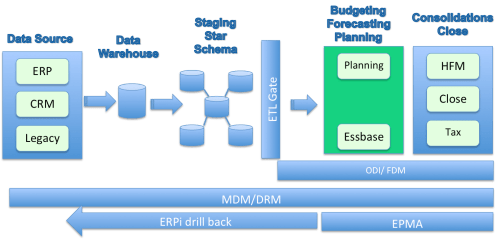
The box in GREEN is what is available on the Oracle Cloud.

Now I know not every consumer of Oracle EPM products have the entire suite like this, but there sure is a subset of some sort.  The point being is that if you have already invested in an on-premise ERP,CRM, EBS, etc system why would you consider the cloud for just a small piece of the overall picture?

Let’s look at what the Oracle Cloud can do and what it cannot:

What you can have on the Oracle Cloud:

  • Workspace
  • Shared Services/Foundation
  • Financial Reporting/Web Analysis
  • Smart view Provider
  • Essbase

However – lets look at the fine print and what it does not do

  • EPMA.  All planning application must be CLASSIC
  • FDM
  • Strategic Finance
  • DRM
  • Planning modules.  (Capex, WFP, Project Planning, HPCM, etc) Only Core planning is supported currently.

3. The underlying technology and setup in many cases are totally opposite than Oracle’s on-premise best practices recommendations.  The cloud service utilizes:

  • 100% Virtual machines (So they can provide cheap and easy high availability)
  • Compact deployments for all components
  • Flat file ETL instead of ODI direct.  You have to FTP flat files to the cloud and the cloud instance actually uses ERPi to load.  Funny – The biggest selling point of ERPi is drill back to source systems – how can you do that when your system is hosted elsewhere?

4.  Is Internet latency going o be a problem when connecting clients?  What about Smartiew connections?  Financial Reporting Studio?

5.  You will still have to administer.  It’s not set-it-and-forget-it.  And handle backup/recovery.  Oh – and don’t forget it’s LINUX!

So is it right for you?

Might be.  If you are a small to midsize company that only wants basic classic Planning budgeting and forecasting, with no HFM, FDM Strategic Finance, etc and has an immature IT department/data center – this may be right up your alley.   I see this an attractive option for a “getting started with Oracle Planning and Budgeting” environment. This is how I envision it look like:

But wait before you run out and sign up.  A few things you need to think about and that we need to ask:

  • You will need to send source data to the Oracle Cloud via FTP in Flat files for ERPi to load into Planning/Essbase.  I would be concerned if that data is really large and/or you have to do it quite frequently.  Also – I hope that Oracle provides secure FTP connections as you are sending raw financial data over the public Internet. For metadata, it seems that the initial load will probably be done with the Outline Load utility and LCM will handle incremental Metatdata migration.
  • How will the Oracle cloud authenticate with your internal corporate directory?  I’m still trying to get information about this.  If you have hundreds of users that authenticate via your internal corporate MSAD or LDAP how does that connection work?   Either you will have to allow for the connection (and Internet latency) for the Oracle Cloud to directly connect to your internal corporate MSAD/LDAP to authenticate each user (not gonna happen) or they will have to furnish their own MSAD/LDAP servers that syncs with yours periodically via a push process (not real time). May be possible but are they going to charge you now for a directory server?
  • What are the backup policies?  Are they going back up the system or does the customer have to do that?  If Oracle does it, how is it done? Does the system need to be down during a backup?  Do I need an offline maintenance window so they can take their VM snapshots at a certain time?
  • What about the database repositories, where do they live?  They are not supported on the Exalytics platform.
  • Considering your development environment on the cloud?  The rumor is that a few organizations are considering the Oracle cloud for their non production (DEV/TEST) systems. My question is why would you not do all or nothing? The whole point of a development and test environment is to simulate a production environment so that we can fully test new functionally and know for sure that it works perfectly before allowing that into my pristine and mission critical production system.  Also – lets not forget about apples-to-apples PERFORMANCE testing in the lower environments. Acceptable performance metrics are a necessary requirement to promote an artifact to production.

Summary

The Oracle Cloud service has the potential to be attractive and fit the bill for certain situations.  However there are a lot of unanswered questions and a lot of considerations when deciding between on-premise or cloud deployments.  You are still going to have day-to-day IT and functional maintenance.  Given the fact that source systems, external authentication security providers, and users are all on-premise there will be technical infrastructure requirements that must be implemented to facilitate on-premise to cloud communication.  I’d take a deep look to fully understand if that will require the same IT knowhow/effort the cloud is trying to supplement.  I will post more as I learn more.  If you participate in the preview program or have anymore info, please feel free to reach out.

What’s New and What’s Coming 11.1.2.3 – the Rumor Mill

•October 6, 2012 • Leave a Comment

Open World Rumors….The next version of EPM will be 11.1.2.3 and is rumored to come out  early next year.   Remember these are just rumors – nothing confirms, so do not kill me if my predictions don’t come true… and certainly do not make any buying decisions on this…


A few things I have heard:


The Functional Side – Short Term/Next Version

  • Healthcare Starter Kit
  • QMR for solvency II, updates for HFM starter kits
  • Major updates to Project Financial Planning and Account reconciliation modules
  • Planning will be able to have ASO and BSO Plan Types.  Should be able to set up a transport partition.  So it may be possible to change data in a composite form in one cube and have it automatically update an ASO for a rolled up number in a report
  • You should be able to launch smartview directly from a form.
  • OBIEE and Workspace integration.
  • Enhancing HFM Journals
  • Should be able to load metadata via smartview


New Hyperion Tax Provision module.

Bring Finance and tax together with unified architecture

Finance and Tax in the same system built on the Financial close suite and HFM

  • data collection
  • tax  calculation
  • Federal and state
  • IFRS, etc
  • Tax KPIs’
  • Mobile
  • Effective Tax rate


A rumored warning:

It is rumored that there will be some significant enhancements to Work Force Planning and that any customizations you have today could break after upgrading. If you have a lot of customizations on WFP, I would let some other be the early adopters just in case.


Long Range Functional Roadmap and Direction

  • Integration HSF and Planning and Project Financial Planning more.  The idea is to start with long rage plan, do scenario modeling, the select your target.  Then – put that metadata into planning.  and push into ASO cube for reporting purposes.
  • Oracle is really Proud of Financial Close Management and is getting great feedback on it.  I think we will see a lot more work on this module such as extending the adapters for more datasources, such as HFM and possible Integration into DRM form metadata perspective,


Technical/Infrastructure – Short Term/Next Version

  • Life Cycle Management will support more if not all artifacts and be backwards compatible to 11.1.1.4 and higher.
  • For High Availability Oracle will support Microsoft Cluster Server and Virtual Machine Failover.
  •  Integrated comprehensive log analysis Tool
  • Better Monitoring tools
  • Better Disk Writing algorithms to increase performance of Essbase


Technical Infrastructure – Long Range Roadmap and Direction

  • Because of the push to get all EPM products on the Exalytics and Linux based Cloud, there is an effort to get all the modules ported to Uni/Linux.  Exalytics is a hard sell for HFM and HFM shops because of it’s Windows requirement. We will see products being ported, starting FDM and then HFM.  They are also researching the effort it would take to convert some of the others such as EPMA, Strategic Finance, and DRM. Once all the products are converted to ADF, the entire suite should be more browser agnostic.


Oracle OOW EPM 11.1.2.2 Claims and Recaps

•October 6, 2012 • Leave a Comment

According to Oracle, the EPM 11.1.2.2 version released this year is the most innovated version of EPM ever.

  • Starting support for Exalytics
  • Project Financial Planning Module
  • Predictive Modeling (from Crystal Ball)
  • Cost and Profitability Module


Essbase on Exalytics Claims:

  • 20x faster writes
  • 80x faster reads
  • 5x more concurrency.


Planning on Exalytics Claims

  • 2.5 times response times improvements
  • Dramatically better performance in public sector apps.


HFM Innovations

  • Unlimited Dimensionality in HFM, custom dimensions
  • New Account Reconsolidations Module – 10 customers already live and in production
  • Pre-built and Starter kits
  • Pre-built Analytic Application OFMA
  • Web 2.0 and ADF


That was 11.1.2.2  What’s Next?  What’s coming in 11.1.2.3?   Stay tuned… I’ll have something soon for you…